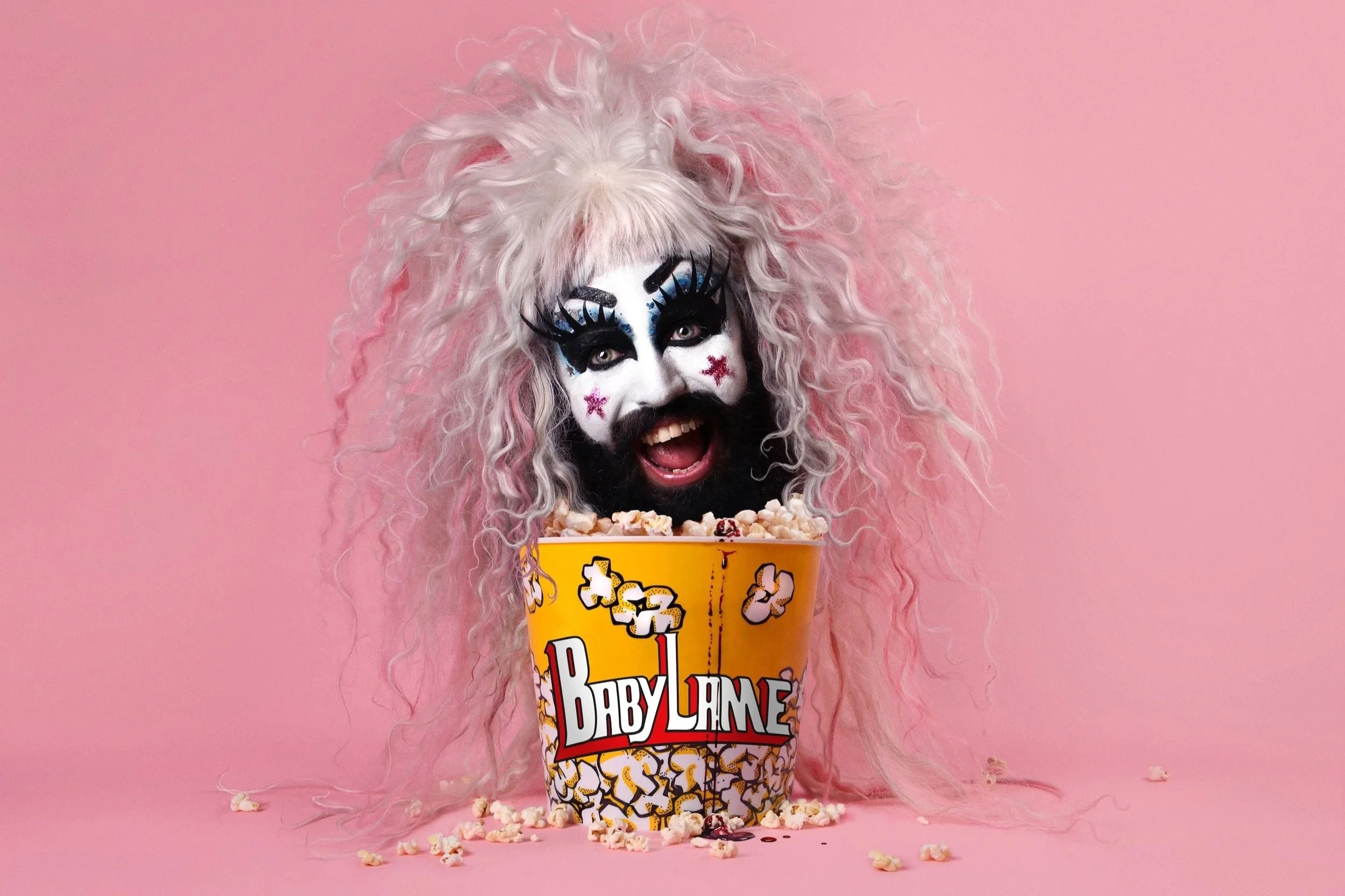
Coco The Time-Travelling Tart: The truth about history’s most powerful people
Power
〰️
Power 〰️
The Edinburgh Fringe is back for 2026, and with it, our annual feature series! This year, we’re taking on POWER: Who’s got it? Where is it? Where should it be? How do you get it? Our comedians are the only ones with the answers.
By Coco The Time-Travelling Tart (aka Max Norman)
People often ask whether I get tired of all the time travelling. Darling, of course I do. Not because of the time-lag — imagine jet lag, but much stranger — but because powerful people have absolutely no chill.
I've spent the last few thousand years circulating among royalty, aristocrats, artists, poets and assorted public nuisances. I've attended their banquets, survived their scandals, witnessed their affairs and, in one regrettable case, briefly married one of them.
What fascinates me is that history remembers these people as monuments. Great rulers. Great artists. Great leaders.
I remember them as people. People who desperately wanted to be admired. People who couldn't bear being ignored. People who turned the smallest slight into an international incident.
Behind every empire, masterpiece and royal scandal, I've usually found the same thing: ego. And trust me, nobody does ego quite like the powerful. Allow me to explain with five people as I knew them.
Mary, Queen of Scots and the handwriting crisis
Historians remain obsessed with the infamous Casket Letters, the documents that allegedly linked Mary, Queen of Scots to the murder of her husband, Lord Darnley, and gave Elizabeth I the justification she needed to keep Mary under lock and key.
Were they genuine? Were they forged? Did they prove Mary's involvement?
I can say categorically that historians have completely misunderstood what was really going on. Mary wasn't trying to conceal a conspiracy. She was trying to conceal her handwriting.
The poor girl was terribly self-conscious about it. It looked like a drunk spider trying to samba across the page. I once watched her spend forty minutes rewriting a single sentence because she kept mangling the word 'wherefore'. 'It's one word, not two,' Elizabeth kept reminding her. She burst into tears and blamed the French education system.
It didn't help that Elizabeth — Fire Crotch, as we called her behind her back — had the sort of immaculate penmanship that made everyone else want to throw themselves into a moat. Elizabeth's letters looked as though they'd been drawn with a ruler. Mary's looked as though they'd been pulled out of a bush.
She found this deeply irritating. I kept telling her nobody would care. Unfortunately, I underestimated historians. For centuries, they have been squinting at those letters trying to determine whether they contain evidence of murder, treason or political intrigue. Half the time, they can barely determine whether they're looking at a capital M.
History remembers one of Scotland's great unsolved mysteries. I remember a young queen who desperately wanted beautiful handwriting and never quite forgave Elizabeth for not having it.
Henry VIII and the seventh wife nobody talks about
People always ask me about Henry as though he were some giant of history. He wasn't. He was a middle child with unlimited resources. Historians focus on the break with Rome, the English Reformation and the reshaping of the nation. I focus on the fact that his older brother Arthur was meant to be king and Henry never quite got over being the spare. (Remind you of anyone?)
I first met him at the Field of the Cloth of Gold where he spent a great deal of time showing off. At one point he challenged Francis I of France to a wrestling match. Francis won. Henry sulked. He wanted to be on top. He had to make do with being a bottom. The mood never really recovered and Europe suffered the consequences.
People think the Tudor period was shaped by religion, politics and dynastic ambition. Personally, I think it was shaped by one man desperately trying to prove he was special. Also, a little gripe: historians insist he had six wives. As wife number seven, I would simply like it on the record that I will never forgive Henry for booking our honeymoon to Lincolnshire.
Lord Byron and the world's first influencer
History remembers Byron as a dangerous Romantic genius. Mad, bad and dangerous to know. Nonsense. I briefly worked as his publicist. The man was obsessed with his image.
Every morning began with a new crisis. Someone had published a rumour. Someone hadn't published a rumour. Someone had failed to appreciate him sufficiently. Someone else appreciated him too much. Exhausting.
People imagine Byron as a tortured outsider. In reality, he spent much of his life travelling around Europe, documenting his feelings and cultivating a mysterious personal brand. Had he been born today, he'd have six million followers, a newsletter and a podcast called Living Authentically.
History remembers the poetry. I remember a man who treated scandal as a competitive sport and collected venereal diseases like souvenirs.
Cleopatra and the pearl
One of my favourite memories is Cleopatra's pearl incident. You've probably heard the story. Cleopatra wagered that she could host the most expensive dinner party in history, dissolved a priceless pearl in vinegar and drank it in front of her guests.
Historians tend to interpret this as a demonstration of wealth and political power. Darling, it was showing off. Glorious, magnificent, world-class showing off. The pearl wasn't the point. The point was that Mark Antony had spent the entire evening being the most interesting person in the room and Cleopatra simply wasn't having it.
She had many admirable qualities. Coming second was not one of them. Twenty minutes later she was drinking jewellery. The room fell silent. Even Antony looked rattled. Two thousand years later we're still talking about it.
The wager worked. I should know, I gave her the idea. After she'd swallowed the vinegar, I shouted across the room, 'Darling, I've swallowed worse.' Mark Antony laughed so hard he nearly inhaled an olive. Cleopatra, meanwhile, simply smiled. The woman knew she'd won.
Caravaggio and the artichokes
Art people adore talking about Caravaggio. The light, the revolutionary compositions, the genius. All true. What they mention less frequently is that he treated minor inconveniences as opportunities for criminal experimentation.
One afternoon we went to eat at a new restaurant. He became involved in an argument with a waiter over a plate of artichokes before throwing it across the room at his head. This sounds ridiculous. That's because it was.
People talk about his masterpieces. I remember us getting thrown out and everyone in Rome quietly checking where the exits were whenever he entered a room. The paintings are immortalised. His behaviour was largely excused.
But aren't those the best bits? The vanity. The insecurity. The gossip. The sheer absurdity of it all. We build statues to these people. We hang their portraits in galleries. We write books about their achievements. What we forget is that they were human. Messy, dramatic, ridiculous.
In other words, exactly like the rest of us. The only difference is that their bad decisions ended up in history books. Mine generally end up in Edinburgh Fringe shows.
Coco the Time-Travelling Tart is running at Underbelly George Square (Buttercup) from Aug 5-30th, 21:45. Tickets here
Read more about Edinburgh Fringe 2026: